Mohenjo-Daro: Echoes of the Indus Valley
Prompt
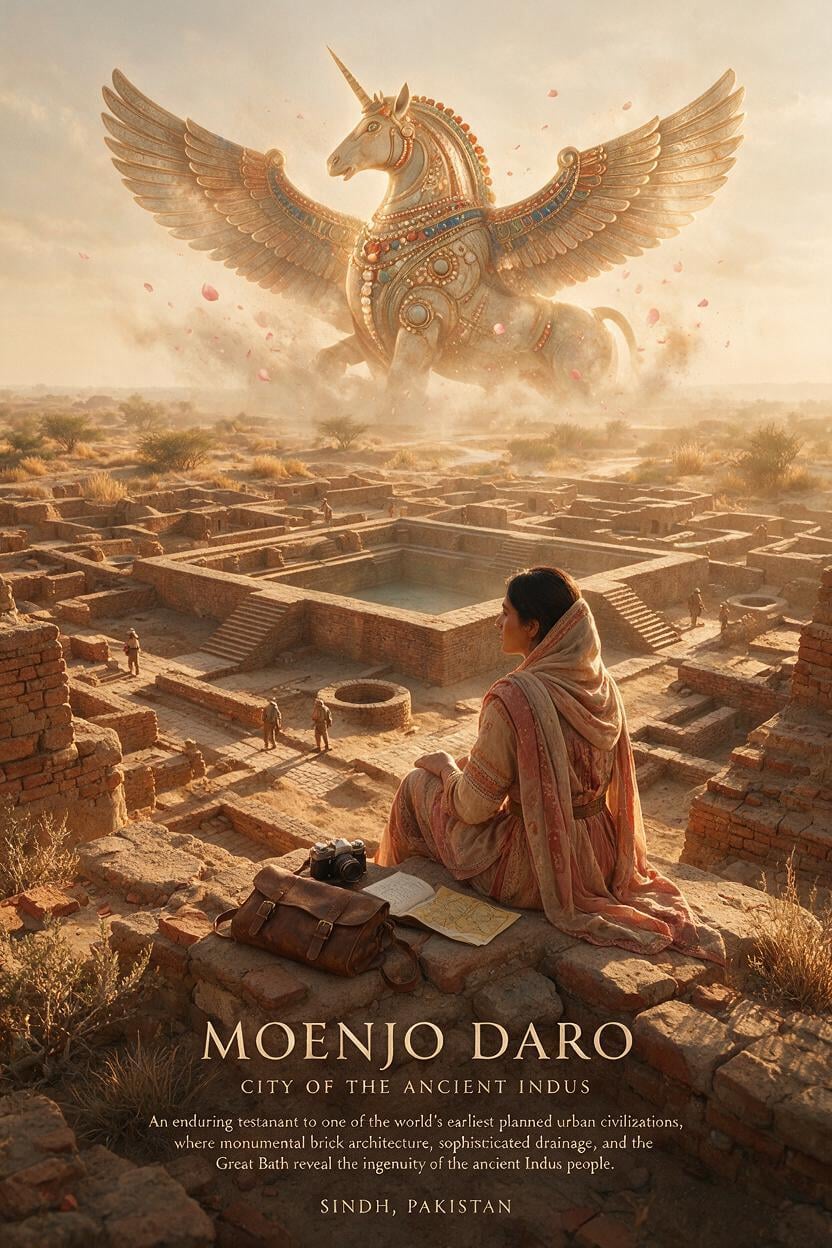
Create a breathtaking vertical cinematic archaeological travel poster of MOENJO DARO, SINDH, PAKISTAN, rendered in hyperrealistic painterly realism with historically grounded details, premium heritage-tourism art direction, and a polished collectible-poster aesthetic.FORMAT AND VISUAL HIERARCHY:Tall 2:3 vertical composition with a strong foreground, midground, and background structure.The visual hierarchy must be:1. Contemporary Pakistani heritage traveller in the foreground2. The Great Bath and excavated urban remains of Moenjo Daro as the principal landmark3. A poetic Indus-seal-inspired mythic guardian in the upper sky4. Integrated destination title and descriptive text at the bottomFOREGROUND SUBJECT:In the lower-left foreground, place a contemporary adult Pakistani woman seated respectfully on a modern stone viewing ledge outside the protected archaeological masonry.Show her in a graceful three-quarter rear pose. Her body faces the ruins while her head turns slightly toward the ancient city, creating a contemplative, emotionally immersive moment.She wears modest, elegant heritage-travel clothing in muted terracotta, sand, ivory, dusty rose, and soft copper:– lightweight long tunic;– softly draped trousers;– wind-touched scarf;– comfortable heritage-inspired footwear.Her styling must remain contemporary rather than resembling an ancient costume.Add restrained handcrafted jewellery inspired by:– carnelian beads;– shell ornaments;– copper details;– geometric Indus motifs.Beside her place:– a weathered brown leather satchel;– a compact vintage camera;– a small archaeological field notebook;– a folded site map.Keep all props secondary and naturally arranged.CENTRAL ARCHAEOLOGICAL LANDMARK:The central focal point is the archaeological cityscape of Moenjo Daro, dominated by an accurate, visually readable interpretation of the Great Bath and its surrounding baked-brick structures.Clearly depict:– the rectangular Great Bath;– stepped entrances descending into the bath;– carefully laid reddish-brown baked bricks;– elevated brick platforms;– adjoining chambers and rooms;– narrow planned streets;– ancient wells;– visible drainage channels;– layered excavated neighbourhoods;– a broad, ordered urban layout extending into the distance.The site must appear low, horizontal, brick-built, expansive, and archaeologically plausible.Do not invent:– monumental palaces;– towering temples;– pyramids;– giant columns;– fantasy citadels;– intact royal complexes;– domes or minarets.AERIAL SYMBOLIC ELEMENT:Above the ruins, include an imaginative mythic guardian inspired by Indus seal iconography.The creature should combine:– the elongated profile of the Indus unicorn motif;– the powerful shoulders and chest of a South Asian humped bull;– broad stylized wings inspired by a regional eagle.Present the creature as poetic visual symbolism, not as a literal historical reconstruction or confirmed Indus deity.Its ceremonial ornamentation should include:– carnelian-red beads;– shell-white details;– oxidized copper;– dark bronze;– restrained lapis-blue accents;– woven geometric bands inspired by Indus ceramics and seal patterns;– subtle tassels and small metallic pendants.The guardian flies diagonally through the upper third of the poster with fully extended wings. Fine dust, tiny dried rose petals, and glowing particles trail behind it. Two or three distant birds of prey fly alongside it while remaining clearly secondary.ENVIRONMENT:Represent the dry alluvial landscape of Sindh near the Indus River.Include:– expansive ochre earth;– sparse tamarisk;– dry grasses;– low riverine haze;– a broad atmospheric horizon;– soft traces of distant floodplain vegetation.Avoid:– dramatic mountains;– tropical jungle;– dense forests;– Arabian desert dunes;– coastal scenery;– modern high-rise buildings.LIGHTING:Use dramatic but natural golden-hour illumination.The ruins should glow in:– amber;– honey;– muted rose;– burnt sienna;– soft copper.Create:– directional sunlight;– long
Copy PromptCopied!golden hourWarm TonesHyperrealisticPainterly RealismcontemplativeMythicIntricate DetailsleatherVisual Hierarchy2:3 aspect ratiotravel posterSeedream 5.0 Pro