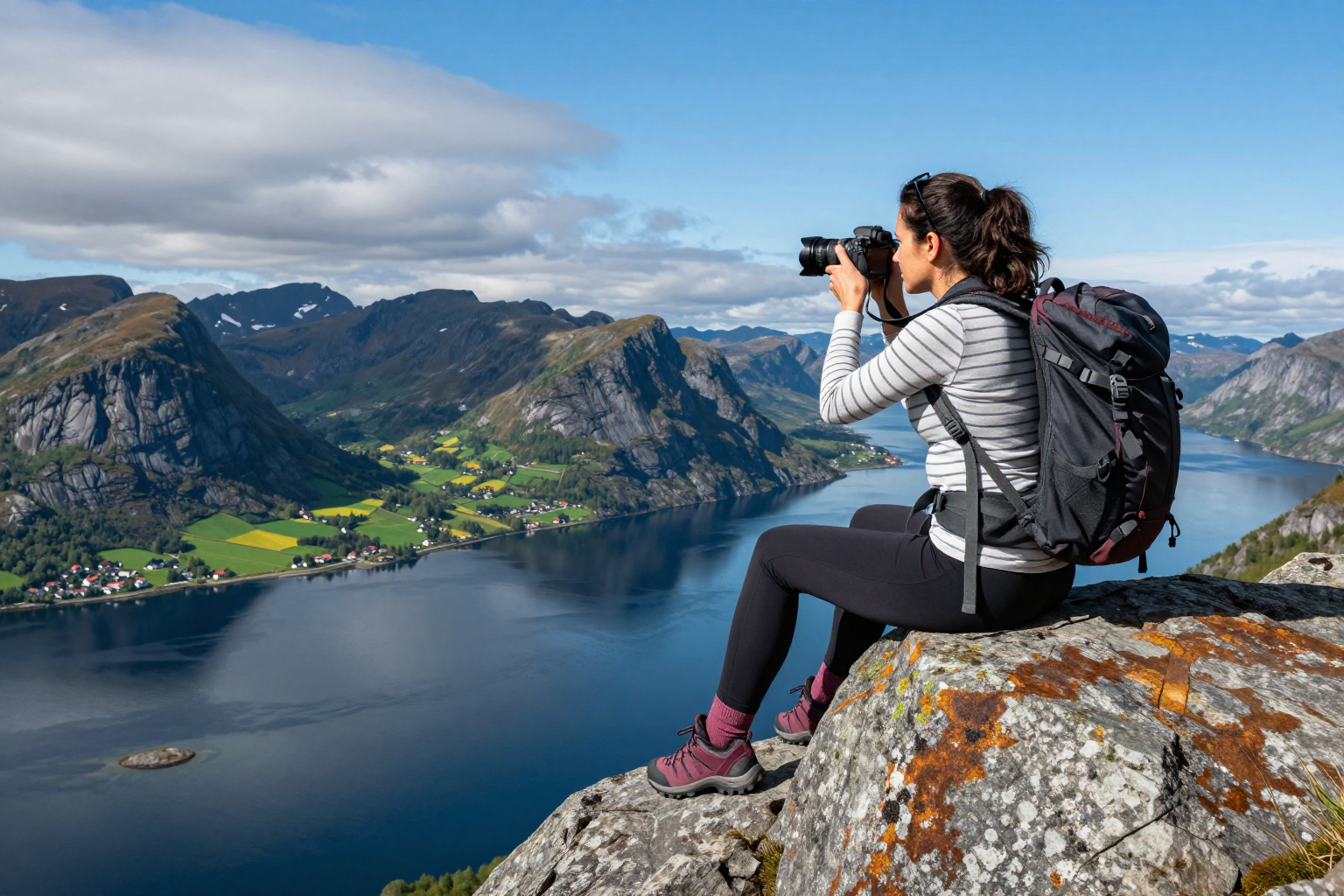
Female Photographer Overlooking Scandinavian Highlands
Prompt
IMAGE FORMAT:Create a horizontal 3:2 landscape image. Use a wide environmental composition with a large sky, an expansive lake or fjord, vivid green farmland, layered rounded mountains and a prominent foreground rock ledge. The image should resemble professional Scandinavian adventure photography or a polished northern European tourism campaign.PRIMARY COMPOSITION:Place one adult female traveler on a large rocky ledge in the right third of the image. The landscape must open broadly toward the left. Position the distant horizon slightly below the vertical center of the frame. Let the sky occupy approximately the upper 35 to 40 percent of the image.The foreground rock should enter from the lower-right corner and project toward the center. The traveler should sit near its outer edge, creating a strong visual contrast between the close human subject and the vast landscape beyond.Keep the traveler large enough for her pose, clothing, camera and backpack to be clearly visible, but do not let her dominate more than approximately the right third of the image.TRAVELER ORIENTATION:Show the traveler from a three-quarter rear and side angle. Her back should face partly toward the viewer while her upper body and face turn toward the left-hand landscape. Do not show a clear frontal face. Her face should be largely obscured by the camera and her profile orientation.She must be actively photographing the landscape through the camera’s viewfinder. Her gaze and camera lens should point toward the left-center mountains and water.POSE:Seat the traveler naturally on the top surface of the rock ledge.Raise the leg closest to her torso, bending the knee sharply toward her chest. Rest that foot securely on the upper rock surface close to the ledge.Extend the other leg downward over the front of the rock, allowing it to hang freely toward the lower-center area of the frame. The dangling leg should create a clear diagonal line.Keep her torso upright but leaning very slightly forward as she concentrates on taking the photograph.Raise both hands to the camera at eye level. One hand should grip the camera body near the shutter button, while the other hand supports or adjusts the lens.Keep both elbows naturally bent. The camera must sit directly in front of her eye rather than being held away from her face.Ensure anatomically accurate body proportions, correctly connected limbs, natural joints and exactly two arms, two hands, two legs and two feet.HAIR AND HEAD:Give the traveler thick dark-brown or black hair tied into a medium-height or high ponytail. Include a few loose strands affected subtly by the breeze. Add realistic daylight highlights to the hair.Optionally place a pair of dark sunglasses securely on top of her head, partially integrated into the hairstyle. Do not place sunglasses over her eyes because she is looking through the camera viewfinder.CLOTHING:Dress the traveler in a fitted long-sleeved casual outdoor shirt with narrow horizontal stripes. Use a white or light-gray base with closely spaced dark-gray or black lines. Make the fabric soft and slightly stretched around the bent arms and torso.Give her fitted black or dark-charcoal hiking leggings or outdoor trousers. The trousers should be slightly cropped above the ankles.Add visible burgundy, dusty-pink or muted-magenta hiking socks.Give her lightweight plum, burgundy or dusty-purple trail shoes with pale midsoles, dark tread and light-colored laces. The shoes must be properly aligned with the feet and rendered with realistic construction.Avoid brand logos, readable labels or recognizable commercial markings.CAMERA:Place a compact black mirrorless or DSLR camera at the traveler’s eye.Use a short to medium-size photographic lens suitable for landscape photography. Show her left hand supporting the lens and her right hand holding the camera grip.Add a dark camera strap hanging naturally from the body or passing around her neck. The strap must not merge with her arms, clothing or backpack st
Copy PromptCopied!sereneAdventurouswide angleRule of Thirdsdeep depth of fieldZ Image Turbo