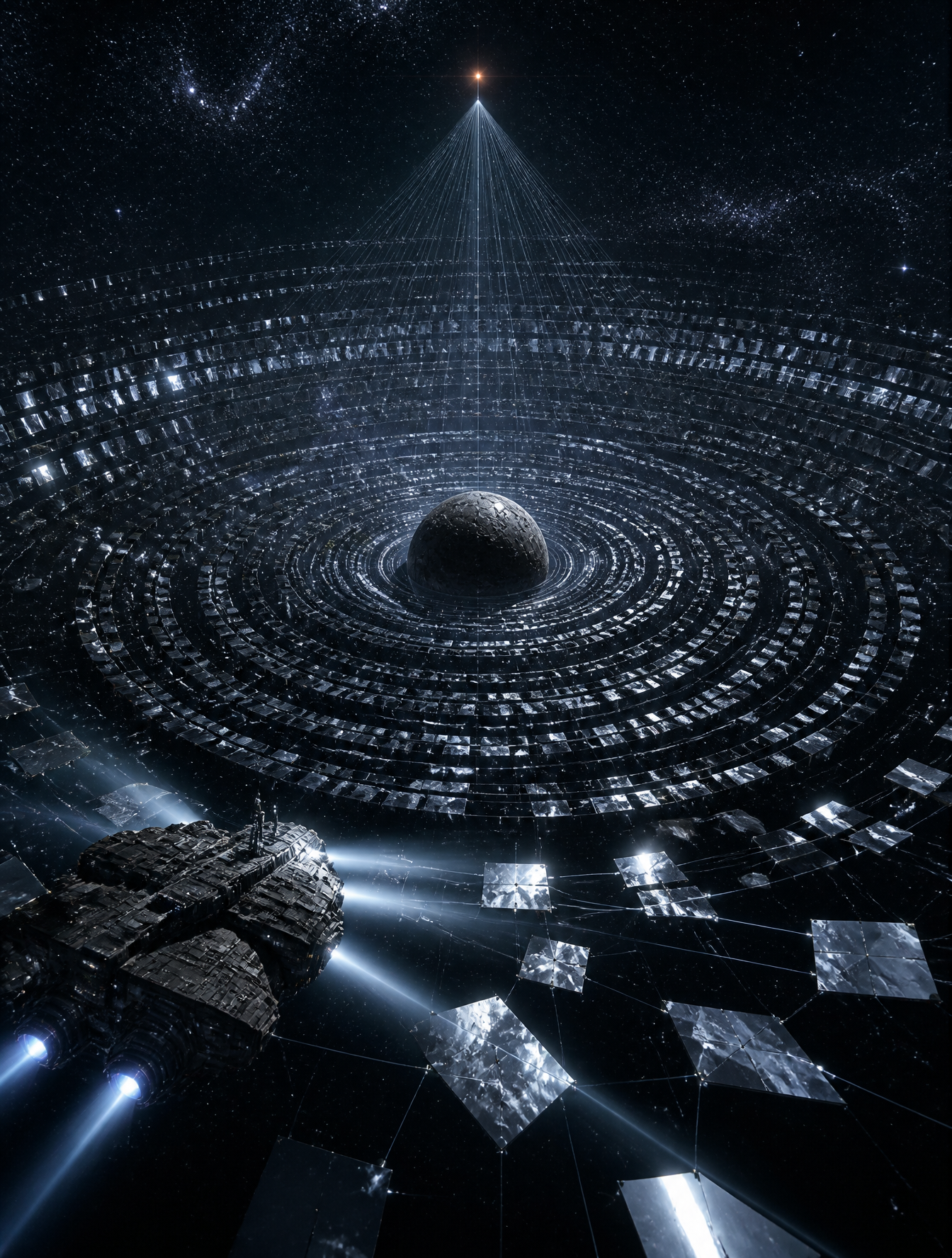
The Frozen Mirror Ring of a Dead Star
Prompt
A cold and magnificent ultra-wide shot of deep space. The remnant of a long-dead star occupies the center of the frame—a neutron star cooled to the edge of absolute zero, only dozens of kilometers in diameter, but with a density equivalent to a sun. It no longer glows; its surface is a solidified iron shell, appearing as a dull metallic gray in the darkness. However, the structure surrounding it is far more shocking than the dead star itself. A massive ring composed of billions of mirror fragments orbits the neutron star in precise orbits, extending tens of thousands of kilometers outward. Each fragment is a perfect planar reflector, ranging in size from several meters to hundreds of meters, coated with a silver-blue reflective film that shimmers with fine, cold light under the reflection of distant starlight. They are not randomly distributed—the entire fragment belt exhibits a meticulously orchestrated layered structure, with density gradually decreasing from inside to outside, resembling some kind of frozen standing wave pattern. Billions of mirrors, all aligned toward a single direction: the north pole of the neutron star. A kilometer-scale human interstellar spaceship slowly enters from the outer edge of the ring. The ship's searchlights sweep across several nearby mirror fragments, and the light reflects repeatedly between the fragments, forming a network of crisscrossing light paths, as if the entire ring were a device built to capture and focus some kind of energy. The ship's sensor array detects a very faint point heat source above the north pole of the neutron star—that was once the focal point of all the mirrors, and now only residual energy echoes remain. The builders have long since disappeared, leaving behind this staggering sea of fragments, silently orbiting an extinguished star, waiting for a beam of light that will never come again.
Copy PromptCopied!Cold TonesLow Saturationmelancholichyper-detailedIntricatespace artGPT Image